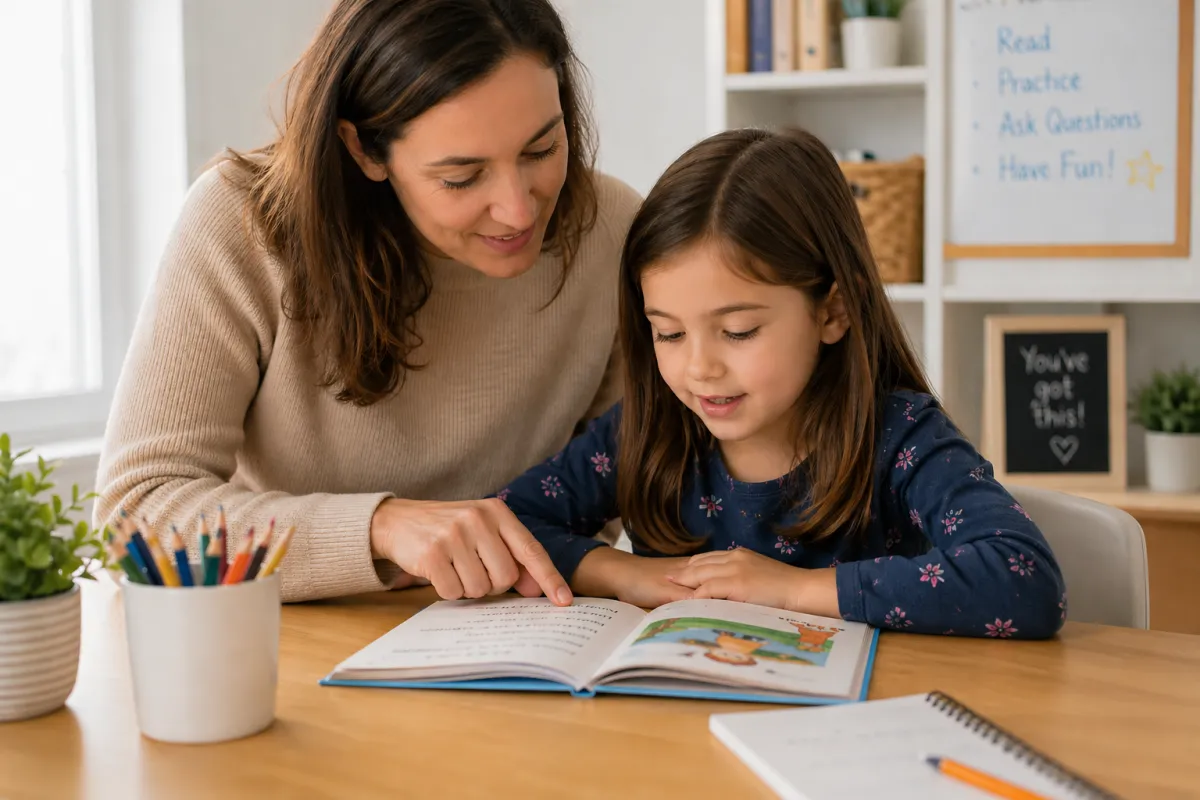
How to Help a First Grader Learn to Read at Home (5-Step Routine)
If your first grader is learning to read, you may be wondering what you can do at home to help.
The good news is that small, consistent practice can make a big difference. You don’t need long lessons or complicated materials—just a simple daily routine that builds strong reading skills over time.
If you’re not sure whether your child needs extra support, you can read about 5 clear signs your child may need a reading tutor.
How to Help a First Grader Learn to Read at Home
Helping a first grader learn to read at home doesn’t have to be complicated. Here’s a simple routine you can use at home to support your child’s reading development.
A Simple 5-Step Daily Reading Routine
Here’s a simple routine you can use at home to support your child’s reading development.
1. Practice Phonemic Awareness (3–5 minutes)
Phonemic awareness is the ability to hear and work with the individual sounds in words (for example, knowing that the word cat is made up of the sounds /c/ /a/ /t/).
Start with quick activities that build your child’s ability to hear and work with sounds in words. This might include saying words slowly and asking your child to repeat the sounds, or playing simple rhyming and sound-matching games. These skills are a key foundation for reading and help your child become more aware of how words are made up of sounds.
2. Work on Phonics (5–10 minutes)
Phonics is learning how letters and sounds work together to read words.
Spend a few minutes practicing letter sounds and how they connect to form words. You can use simple word lists or practice reading and building words together. This helps your child learn how to decode unfamiliar words when reading and builds confidence over time.
3. Read a Decodable Book (5–10 minutes)
A decodable book uses words your child has the skills to sound out, so they can practice reading with confidence.
Choose a book that matches the phonics skills your child is learning. Sit together and support them as they read, helping when needed but allowing them to do as much as they can on their own. Reading books at the right level helps your child feel successful and reduces frustration.
4. Reread for Fluency (3–5 minutes)
Fluency is reading smoothly and easily, without sounding slow or choppy.
Go back and reread a familiar book. This helps your child read more smoothly and with better expression over time. As reading becomes easier, your child can focus more on understanding the story.
5. Talk About the Book (3–5 minutes)
After reading, spend a few minutes talking about the story. Ask simple questions like “What happened in the story?”, “What is one thing that you learned?”, or “Why do you think that character did that?” This builds understanding and helps your child make meaning from what they read.
This routine doesn’t need to be perfect or take a long time to be effective.
Even 15–20 minutes a day can make a meaningful difference when it’s consistent and focused on the right skills. Some days will go more smoothly than others—and that’s okay. The goal is to build steady progress over time, not perfection.
If you’re wondering if your first grader is on track with reading, even with support at home, it can be helpful to take a closer look at what specific skills need more attention.
If your first grader is struggling, you can also read about common causes of reading difficulties and how to help.
As a reading specialist, I work with first graders and older elementary students to build strong reading foundations using structured, individualized instruction.