What Is Phonemic Awareness? A Parent-Friendly Guide to This Essential Reading Skill
If you've ever talked with a teacher, reading specialist, or tutor about your child's reading development, you may have heard the term phonemic awareness.
Many parents are familiar with phonics, sight words, and reading fluency, but phonemic awareness is often a less familiar concept. However, phonemic awareness is an important foundational skill that supports learning to read.
The good news is that phonemic awareness doesn't require books, worksheets, or even letters. It is simply the ability to hear and work with the individual sounds in spoken words.
Let's take a closer look at what phonemic awareness is, why it matters, and how parents can help strengthen this important skill at home.
What Is Phonemic Awareness?
Phonemic awareness is the ability to hear, identify, blend, segment, and manipulate the individual sounds (phonemes) in spoken words. It is an auditory skill that does not require letters or print.
Children typically begin developing phonemic awareness skills during preschool and kindergarten and continue strengthening them as they learn to read in the early elementary grades.
Unlike phonics, phonemic awareness focuses on hearing and working with the sounds in spoken words rather than looking at letters or printed words. Children often begin practicing these skills through listening activities. As they start learning phonics, they gradually connect the sounds they hear to the letters they see.
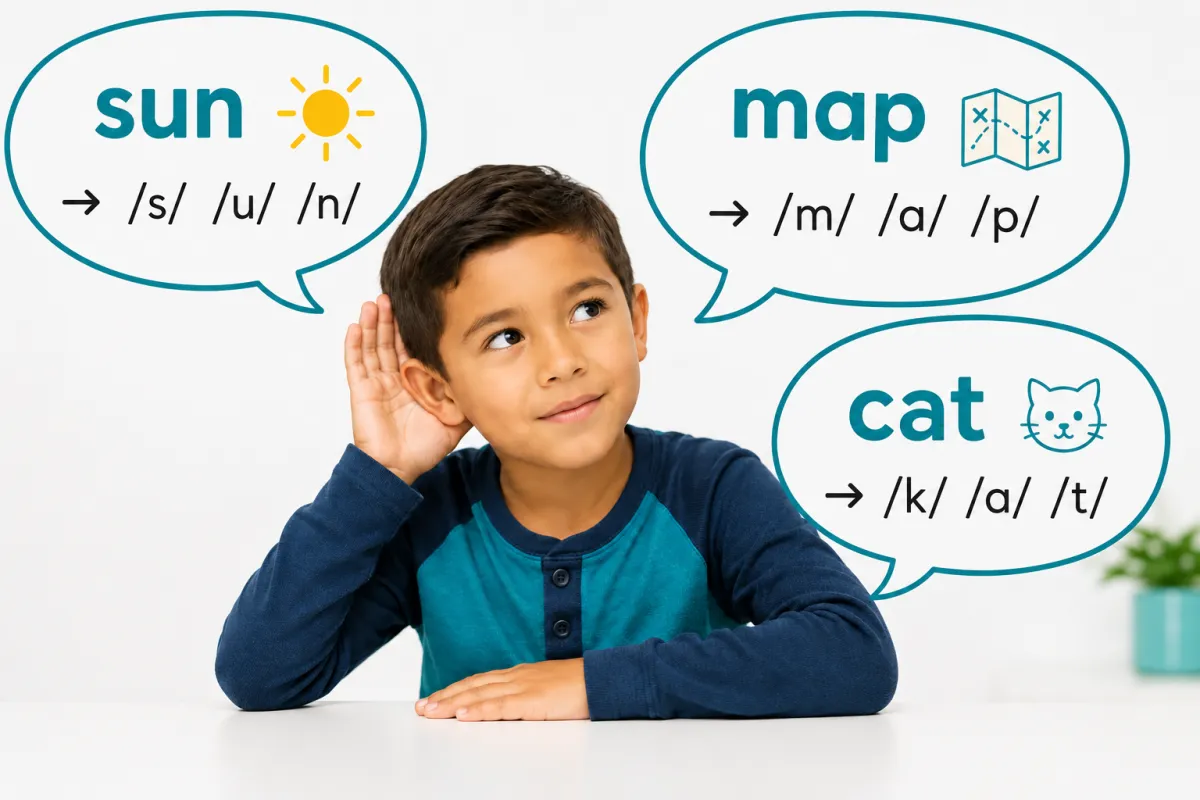
For example, a child demonstrating phonemic awareness might:
Identify the first sound in sun (/s/)
Blend the sounds /m/ /a/ /p/ to say map
Break the word cat into its individual sounds (/k/ /a/ /t/)
Say smile without the /s/ sound (mile)
These skills may seem simple, but they play an important role in helping children learn to read and spell.
Why Is Phonemic Awareness Important?
Learning to read is a complex process, and phonemic awareness is one of the building blocks. When children can hear and work with the sounds in spoken words, they are developing skills that support reading and spelling success.
Think about the word cat. Before a child can read the printed word cat, they need to understand that the spoken word is made up of three sounds: /c/ /a/ /t/. Phonemic awareness helps children hear those individual sounds and understand that words can be broken apart and put back together again.
This skill provides an important foundation for phonics. As children learn that letters represent sounds, they begin connecting the sounds they hear in spoken words to the letters they see in print.
Phonemic awareness also supports spelling. When children spell a word, they listen for the sounds they hear and match those sounds to letters. A child who can hear the individual sounds in map is better able to represent those sounds when writing the word.
The encouraging news is that phonemic awareness can be taught and strengthened through explicit instruction and playful practice. Many children make significant progress when they are given opportunities to listen to, identify, blend, segment, and manipulate sounds in words.
Signs a Child May Need More Practice With Phonemic Awareness
Every child develops at their own pace, but some children benefit from additional practice with phonemic awareness skills. A child may benefit from additional practice if they have difficulty:
Recognizing words that rhyme (cat, hat)
Identifying the first sound in a word (What sound does sun begin with?)
Blending individual sounds together to make a word (/m/ /a/ /p/ = map)
Breaking a word into its individual sounds (dog = /d/ /o/ /g/)
Adding, deleting, or substituting sounds in words (Say map; now change the /a/ to /o/ = mop)
It's important to remember that phonemic awareness is an auditory skill. A child may know many letter names and sounds but still need additional practice hearing and working with the sounds in spoken words.
If your child struggles with these skills, don't panic. Many children improve with explicit instruction and regular practice.
While difficulty with phonemic awareness does not automatically indicate a reading problem, it can be one of several signs that a child may benefit from additional reading support.
Easy Ways to Build Phonemic Awareness at Home
The good news is that phonemic awareness can be practiced throughout the day without worksheets, flashcards, or special materials. Because phonemic awareness focuses on spoken language, many activities can be done during everyday routines.
Here are a few simple ways to practice phonemic awareness at home:
Play "I Spy" With Sounds
Instead of focusing on colors, focus on sounds.
For example:
"I spy something that starts with /b/."
Your child can look around and guess objects that begin with that sound.
Practice Oral Blending
Say the sounds in a word slowly and ask your child to blend them together.
For example:
"/s/ /u/ /n/"
Your child says:
"sun"
As children become more confident, try longer words.
Try Rhyming Games
Take turns thinking of words that rhyme.
For example:
cat, hat, bat, sat
Some words can be silly nonsense words. The goal is simply to hear the similarities in the ending sounds.
Play "Say It Without..."
Ask your child to say a word without one of its sounds.
For example:
"Say boat without the /b/ sound."
Answer:
"oat"
This activity helps children develop more advanced phonemic awareness skills.
Remember, these activities should feel playful rather than stressful. A few minutes of practice here and there can help strengthen your child's awareness of sounds in words.
Looking for more ways to support reading at home? Here are additional strategies for helping your child learn to read at home.
Phonemic Awareness vs. Phonics: What's the Difference?
Although the terms phonemic awareness and phonics are often used together, they are not the same thing.
Phonemic awareness focuses on hearing and working with the sounds in spoken words. No letters or printed words are involved.
Phonics focuses on connecting those sounds to letters and using that knowledge to read and spell words.
For example, if a child hears the sounds /c/ /a/ /n/ and blends them together to say can, they are using phonemic awareness.
If a child sees the letters c-a-n and reads the word can, they are using phonics.
Both skills are important, and they work together to support reading development!
Final Thoughts
Phonemic awareness is one of the foundational skills that supports learning to read. By helping children hear, identify, and manipulate the sounds in spoken words, phonemic awareness lays the groundwork for future reading and spelling success.
The good news is that phonemic awareness can be developed through explicit instruction and playful practice. Simple activities such as rhyming, blending sounds, and playing listening games can help strengthen these important skills over time.
If you're concerned about your child's reading development or have questions about their phonemic awareness skills, a free reading assessment can help identify strengths and areas where additional support may be beneficial.
As a former first-grade teacher and reading specialist, I offer free reading assessments for families who want a clearer picture of their child's reading strengths and needs.