What Every Parent Should Know About the Science of Reading
You may have heard the phrase "Science of Reading" during a parent-teacher conference, seen it on your school's website, or noticed a reading tutor describing their instruction as "Science of Reading-based."
If you've been wondering what the Science of Reading really means—and why you're hearing so much about it—this is a helpful place to start. Learning more about the Science of Reading can help you become a more informed partner in your child's education, whether you're talking with your child's teacher, choosing reading support, or simply wondering how children learn to read.
Why Is Everyone Talking About the Science of Reading?
The Science of Reading is receiving so much attention because it gives parents, teachers, and reading specialists confidence that there is an effective, evidence-based way to teach children to read. Rather than relying on opinions or educational trends, it reflects decades of research on how children learn to read and on the teaching practices that help them develop strong reading skills.
Years of scientific research have helped us better understand how reading skills develop. Researchers have discovered that learning to read isn't a natural process like learning spoken language. While children naturally learn spoken language simply by being surrounded by it, learning to read requires explicit, evidence-based instruction and practice.
As researchers continue to learn more, our understanding of how children learn to read continues to grow. That gives teachers, reading specialists, and parents greater confidence that children can learn to read through instructional practices grounded in research and evidence.
How Do Children Learn to Read?
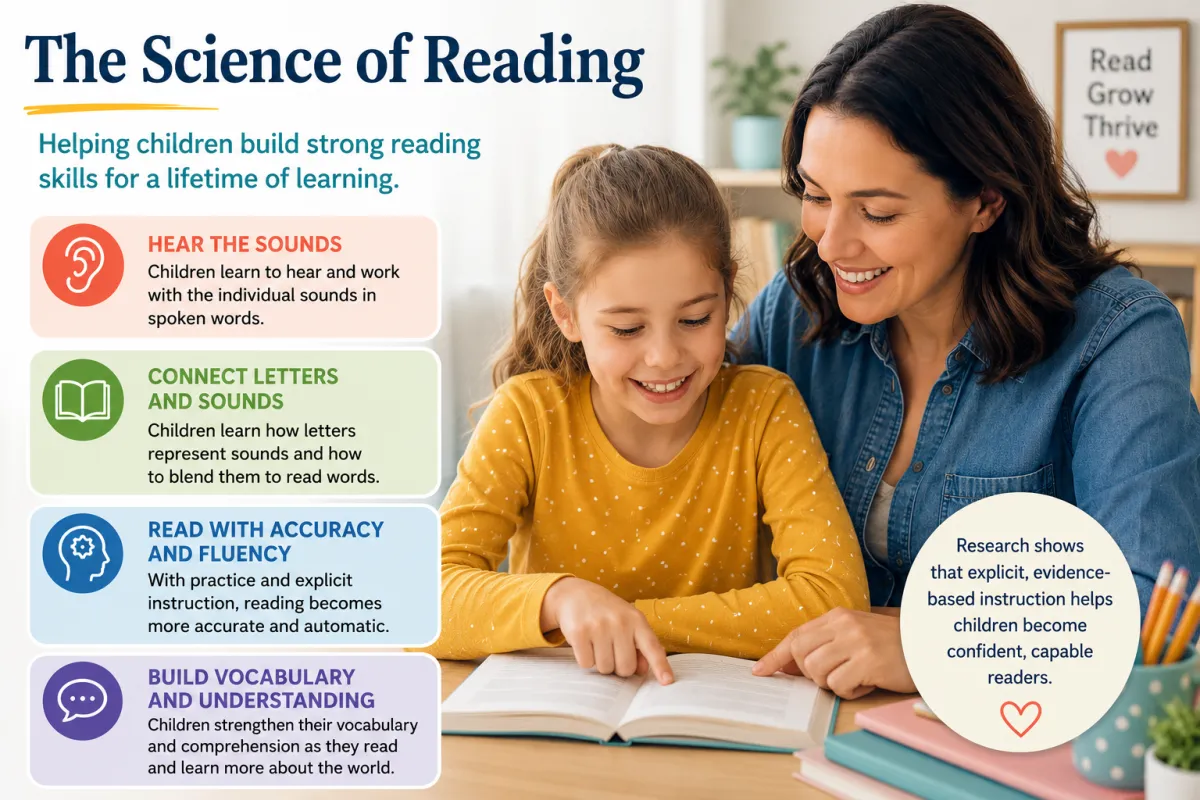
One of the most important things researchers have discovered is that children don't learn to read naturally or all at once. Instead, they develop reading through a series of skills that build on one another over time. Rather than learning all of these skills at once, children gradually develop them through explicit instruction, meaningful practice, and opportunities to apply what they've learned.
Understanding these skills has helped teachers provide more effective reading instruction while giving parents a clearer picture of how children learn to read.
Children first learn to hear and work with the individual sounds in spoken words. This skill is known as phonemic awareness. For example, they learn to hear that the word cat is made up of three individual sounds: /k/ /a/ /t/. They then learn how letters represent those sounds and how to use that knowledge to read unfamiliar words. For example, a child who knows the sounds for the letters m, a, and p can blend those sounds together to read the word map. You can learn more about decoding here. As they receive explicit instruction and have opportunities to practice these skills, reading becomes more accurate, more fluent, and eventually more automatic. A child who once slowly sounded out the word jump may eventually recognize it instantly without needing to stop and think about each individual sound. At the same time, they continue to build vocabulary and strengthen their ability to understand what they read.
Understanding how children learn to read helps explain why effective reading instruction is so important. When teachers understand how reading skills develop, they can provide instruction that builds those skills in a logical, research-informed way. For parents, this knowledge provides confidence that there is an effective approach to teaching reading and a better understanding of what to look for as their child grows as a reader.
What Does the Science of Reading Mean for Parents?
Learning about the Science of Reading can help you better understand your child's reading journey, ask informed questions, and confidently partner with your child's teacher or reading specialist.
When reading instruction reflects what research has taught us, children have the opportunity to build strong foundational reading skills that support future learning.
Whether you're talking with your child's teacher, choosing reading support, or simply encouraging reading at home, understanding the Science of Reading gives you a stronger foundation for those conversations and decisions.
Where Can I Learn More?
The Science of Reading is a broad topic, and this article provides just an introduction. As you continue exploring the Blog, you'll find additional articles that explain the key ideas behind effective reading instruction in parent-friendly language.
Final Thoughts
The next time you hear the phrase "Science of Reading," you'll know it isn't the name of a program or curriculum. It's the result of decades of research that continues to help teachers, reading specialists, and parents better understand how children learn to read and how we can best support them.
Just as importantly, this growing body of research gives us confidence that, with explicit, evidence-based instruction, meaningful practice, and encouragement, children can develop into confident readers.
If you're wondering whether your child would benefit from a reading assessment, be sure to read my article, Does My Child Need a Reading Assessment Before School Starts?