Does My Child Need a Reading Assessment Before School Starts?
Should I schedule a reading assessment before school starts, or should I wait and see how my child does once the school year begins?
If you've been asking yourself this question, you may be wondering whether your child is truly ready for the next school year. Maybe reading was difficult last year. Maybe your child avoids reading at home, guesses at words, or still struggles to sound out unfamiliar words. Or perhaps you simply have a feeling that something isn't quite clicking yet.
At the same time, it's completely understandable to wonder whether you're worrying too much. After all, children grow and change quickly, and many parents hope a fresh start in a new classroom will make a difference.
A reading assessment isn't about labeling a child. Its purpose is to provide clarity. A quality reading assessment helps identify your child's reading strengths, the skills they are still developing, and whether additional support may be beneficial before the school year begins.
In this article, you'll learn when a reading assessment may be helpful, what it can tell you, and how to decide whether it's the right next step for your child.
What Is a Reading Assessment?
When many parents hear the words reading assessment, they picture a test that gives their child a score or grade. In reality, a quality reading assessment is much more than that. An effective assessment looks beyond one score to build a more complete picture of your child’s reading development. If you'd like to better understand how children learn to read, my article, What Every Parent Should Know About the Science of Reading, provides a helpful foundation for understanding why comprehensive reading assessments are so valuable.
Its purpose isn't to label a child or simply determine whether they are "behind." Instead, it helps identify which reading skills are already developing well and which skills may need additional support.
Reading is made up of many different skills that work together. A child may have difficulty reading for several different reasons, and those reasons aren't always obvious from listening to them read aloud. A comprehensive reading assessment looks beneath the surface to understand why a child is struggling, not just that they are struggling.
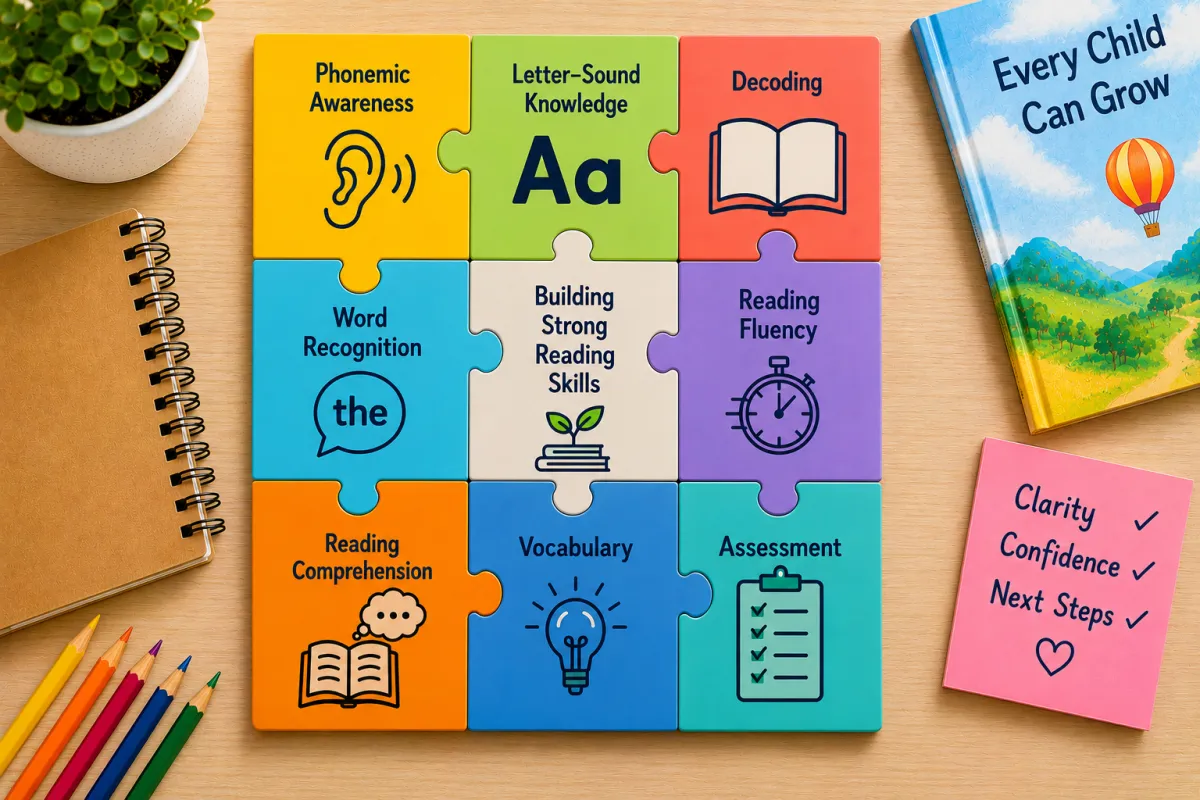
Depending on your child's age, an assessment may look at skills such as:
Phonemic awareness (hearing and working with the individual sounds in spoken words)
Letter-sound knowledge
Decoding (using letter sounds to read unfamiliar words)
Word recognition
Reading fluency
Reading comprehension
The goal is to create a clear picture of your child's current reading development so that any support they receive is focused on the skills they need most.
How Do I Know If My Child Might Benefit from a Reading Assessment?
You don't need to schedule a reading assessment simply because a new school year is approaching. Many children are ready to begin the next grade without any concerns.
However, if you've noticed some of the following signs, an assessment may provide helpful information before school starts.
"My child guesses at words instead of sounding them out."
Many beginning readers occasionally guess at words. However, if your child frequently looks at the first letter and then guesses the rest of the word, it may be a sign that they haven't yet developed strong decoding skills. A reading assessment can help determine whether your child is using effective word-reading strategies.
"Reading is becoming frustrating."
Does your child avoid reading, become upset during homework, or quickly say, "I can't do it"?
While frustration doesn't automatically mean there's a reading difficulty, children often become discouraged when reading feels much harder than it should. An assessment can help identify whether there's an underlying skill that's making reading more difficult.
"My child still has trouble sounding out unfamiliar words."
It's common for beginning readers to encounter words they don't know. The question is how they approach those words.
Children who have developed decoding skills attempt to work through unfamiliar words by using the letters and sounds they know. If your child consistently guesses, skips words, or gives up instead of trying to decode them, an assessment can help determine which foundational reading skills may need additional support.
"I'm just not sure if my child is where they should be."
Sometimes there isn't one specific concern.
Instead, parents simply have a feeling that reading isn't coming as easily as expected. Perhaps you're just not sure if your child is truly prepared for the next school year.
That's a perfectly reasonable reason to seek a reading assessment. Sometimes the greatest benefit isn't discovering a problem—it's gaining confidence that your child is on track, or learning exactly where they could benefit from additional support.
What Can a Reading Assessment Tell You?
One of the greatest benefits of a quality reading assessment is that it helps answer an important question:
Why is reading difficult for my child?
Two children may both struggle with reading, but for very different reasons. One child may have difficulty hearing and working with the individual sounds in spoken words, while another may know letter sounds but struggle to blend them together to read unfamiliar words. A third child may read words accurately but slowly, making it difficult to understand what they are reading.
Without a thorough assessment, these differences aren't always easy to recognize. A child who says, "I don't like reading," may be experiencing frustration for reasons that aren't immediately obvious.
A quality reading assessment helps identify your child's strengths as well as the skills they are still developing. Rather than relying on guesswork, parents and educators can use this information to make informed decisions about how to best support the child's reading growth.
For example, an assessment may help answer questions such as:
Does my child have strong phonemic awareness skills?
Can my child decode unfamiliar words, or are they relying on guessing?
Is my child's reading becoming accurate and automatic?
Are reading difficulties affecting comprehension?
Which reading skills should we focus on first?
The answers to these questions can guide conversations with your child's teacher, help you choose effective activities to practice at home, and determine whether additional support may be beneficial.
Most importantly, a quality assessment provides something many parents are looking for before the school year begins: clarity. Instead of wondering what might be happening, you'll have a better understanding of where your child is in their reading development and what steps, if any, would be most helpful moving forward.
What Happens During a Reading Assessment?
A reading assessment is typically a series of age-appropriate activities designed to understand how your child approaches reading. Depending on your child's age and reading development, they may be asked to identify letters and sounds, read words and passages, answer questions about what they read, or complete other age-appropriate tasks that help assess different reading skills. A quality assessment should feel supportive and encouraging, giving your child opportunities to demonstrate what they know while helping the assessor identify which skills may benefit from additional instruction.
Should I Wait Until School Starts to Schedule a Reading Assessment?
This is one of the most common questions parents ask before a new school year begins.
The honest answer is: it depends on your child's situation.
If your child finished the previous school year reading confidently, enjoys books, and hasn't shown any ongoing signs of difficulty, there's usually no reason to schedule a reading assessment simply because school is about to start.
However, if your child struggled throughout the previous school year, frequently guesses at words, avoids reading, or if you're entering the new school year with unanswered questions, waiting may simply extend that uncertainty.
One advantage of scheduling a reading assessment before school begins is that it provides information before classroom instruction is in full swing. Instead of spending the first several weeks wondering whether your child is catching up, you'll have a clearer understanding of their current reading skills and whether any additional support may be helpful.
It's also important to remember that an assessment doesn't commit you to tutoring or any particular intervention. Sometimes the results simply reassure parents that their child is on track. Other times, they identify a specific skill that can be strengthened through targeted practice at home, classroom instruction, or additional support if needed.
The goal isn't to rush into a decision. The goal is to make an informed one.
What Questions Should I Ask Before Scheduling a Reading Assessment?
Not all reading assessments are the same. If you're considering having your child assessed, it's helpful to understand what information you'll receive and how the results will guide your next steps.
Here are a few questions you may want to ask:
What reading skills will be assessed? A comprehensive reading assessment should look at multiple areas of reading development, not just whether your child can read a list of words or answer comprehension questions.
Will I receive an explanation of the results? Assessment results are most valuable when they're explained in clear, parent-friendly language that helps you understand your child's strengths and areas for growth.
Will I receive recommendations for next steps? A quality assessment should provide practical guidance based on your child's individual needs. Depending on the results, recommendations may include activities to practice at home, classroom supports, or additional instruction.
How will the assessment help explain why my child is struggling? The goal isn't simply to confirm that reading is difficult. It's to better understand the underlying skills that may need additional support.
Can I ask questions about the results? Parents should leave an assessment feeling more informed and confident than when they arrived. You should have the opportunity to ask questions and understand what the results mean for your child.
Final Thoughts
If you're wondering whether your child needs a reading assessment before school starts, remember that the goal isn't to look for problems or assume the worst.
Instead, the goal is to gain a clearer understanding of your child's reading development so you can make informed decisions with confidence.
For many families, that clarity simply provides reassurance that their child is on track. For others, it identifies specific skills that can be strengthened before small difficulties become larger ones.
Whatever the outcome, understanding your child's current reading skills is one of the best ways to support their growth as a reader.
If you're still unsure whether a reading assessment would be helpful, start by talking with your child's teacher or a qualified reading specialist. Together, you can decide whether an assessment is the right next step based on your child's individual needs.
Frequently Asked Questions About Reading Assessments
Is a reading assessment the same as a reading test?
Not exactly. While both involve reading tasks, a reading assessment is designed to gather information about how your child reads and which skills are developing well. Rather than giving your child a grade or pass/fail score, a quality reading assessment helps identify their strengths, the skills they are still developing, and where additional support may be helpful. The goal isn't to label a child—it's to better understand how they learn to read so parents and educators can make informed decisions about the next steps.
How long does a reading assessment take?
The length of a reading assessment depends on your child's age, the purpose of the assessment, and the skills being evaluated. Some school screening assessments take just a few minutes, while more comprehensive reading assessments may take an hour or longer. If your child is participating in a private reading assessment, ask the reading specialist how long to expect and what skills will be assessed. Regardless of the length, the goal is the same: to gather enough information to understand your child's reading strengths, identify any areas of need, and recommend appropriate next steps.
What age should a child have a reading assessment?
There isn't a single age that's right for every child. A reading assessment may be helpful whenever there are concerns about a child's reading development, regardless of age. Some children benefit from an assessment as they begin learning to read, while others don't show signs of difficulty until reading demands increase in the elementary years. If you're unsure whether your child is making expected progress in reading, a reading assessment can provide valuable information about their current reading skills and help guide the next steps.
Will My Child Need to Prepare for a Reading Assessment?
No. A reading assessment is designed to understand your child's current reading skills, so there's no need to study or practice beforehand. In fact, it's most helpful when the assessment reflects what your child knows and can do on a typical day. To help your child feel comfortable, make sure they get a good night's sleep, eat a healthy meal or snack beforehand, and let them know the assessment is simply an opportunity to show what they know. The goal isn't to earn a grade—it's to better understand how to support your child's reading development.
Will My Child Receive a Grade or Score?
It depends on the type of reading assessment. Some assessments provide scores, performance levels, or grade-level expectations, while others simply describe your child's strengths and areas for growth. Because reading is made up of many different skills, it's common for each area—such as phonemic awareness, decoding, word recognition, fluency, and reading comprehension—to be assessed and interpreted separately. This helps identify which skills are developing well and which may benefit from additional support. The most valuable part of a reading assessment isn't the score itself—it's understanding what the results mean and how they can guide your child's reading growth.
Continue Learning About Reading
If you'd like to learn more about the skills discussed in this article, these resources are a great place to start:
Still Wondering Whether a Reading Assessment Is Right for Your Child?
If you're unsure whether your child would benefit from a reading assessment before school starts, a comprehensive assessment can provide a clearer understanding of your child's reading strengths and the skills they are still developing.
With that information, you can make informed decisions about the next steps to support your child's reading journey.