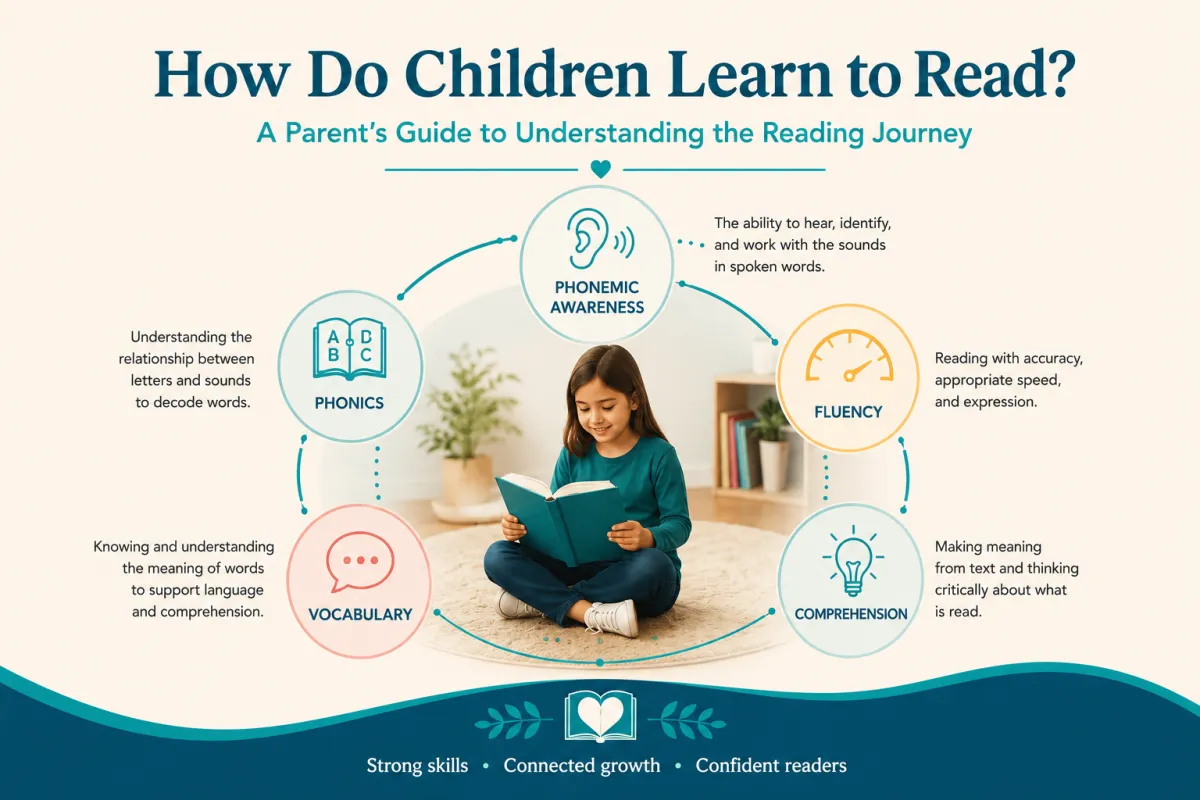
How Do Children Learn to Read?
Have you ever wondered how children learn to read?
During my 24 years in education, I taught kindergarten, first grade, and third grade and also served as a school-wide reading specialist in two different elementary schools, where I worked with students in kindergarten through fourth grade. One of the greatest joys of my career was helping children grow as readers. At the beginning of each school year, every classroom was filled with children at different points in their reading journey. Some knew only a few letters and sounds, while others were reading chapter books. Watching each child make meaningful progress over the course of the year was one of the most rewarding parts of teaching.
Learning to read doesn't happen through a single lesson or skill. Instead, children gradually build the knowledge and abilities they need to become successful readers. Although learning to read may seem like it happens naturally, it is actually one of the most complex skills a child learns. Decades of research have helped us understand the most effective ways to teach children to read, which is known as the Science of Reading. Unlike speaking, which most children acquire naturally through everyday conversations, reading requires the brain to build new connections between letters, sounds, and meaning.
Essential reading skills develop together over time, strengthening one another as children become more confident readers. Understanding this journey can help you better support your child, celebrate their progress, and recognize when they may need extra help.
In this article, you'll learn how children develop into skilled readers, explore the five essential building blocks of reading, and discover why every child's reading journey is unique.
How Children Learn to Read
Learning to read isn't a single skill that children master all at once. Instead, it's a gradual process of developing several essential reading skills that work together. As children practice and gain experience, these skills become stronger and more automatic, making reading easier and more enjoyable.
Researchers have identified five essential components of reading: phonemic awareness, phonics, fluency, vocabulary, and comprehension. Rather than developing in isolation, these components grow together over time, supporting one another as children become confident readers.
Each of these five essential reading components plays an important role in your child's reading development. When one area needs extra support, it can affect overall reading progress. The good news is that these skills can be strengthened through high-quality instruction, practice, and encouragement.
Let's take a closer look at each of these five essential reading components and why they matter in your child's reading journey.
1. Phonemic Awareness: Hearing the Sounds in Words
Before children can connect letters to sounds, they first need to hear the individual sounds that make up spoken words. This listening skill is called phonemic awareness. It involves recognizing, identifying, and manipulating the individual speech sounds in spoken words—all without looking at printed letters.
Why is this important? Children who can hear and work with the sounds in words are better prepared to learn phonics and decode unfamiliar words. Strong phonemic awareness gives children the foundation they need to become successful readers and spellers.
At home, you might notice your child:
recognizing rhyming words
clapping syllables in words
identifying the first or last sound they hear in a word
blending individual sounds together to make a word ("/k/ /a/ /t/" becomes cat)
breaking a word apart into its individual sounds
These playful listening activities may seem simple, but they are building one of the most important foundations for learning to read.
2. Phonics: Connecting Letters and Sounds
As children develop the ability to hear the individual sounds in spoken words, they begin connecting those sounds to printed letters. This process, called phonics, helps children understand that letters represent the sounds they hear in spoken language. With explicit instruction and practice, they learn to use these letter-sound relationships to decode (sound out) unfamiliar words and recognize familiar words more easily.
Why is this important? Phonics gives children the tools they need to read words they have never seen before. Rather than relying on pictures or guessing, children learn to use letter-sound relationships to figure out words independently. As their decoding skills become more accurate and automatic, reading becomes easier and more enjoyable.
At home, you might notice your child:
sounding out unfamiliar words while reading
using letter sounds to figure out a word instead of guessing
recognizing common spelling patterns, such as -at, -ing, or -ake
becoming more confident reading books with words they can decode
Learning phonics takes time and practice, but it gives children a reliable strategy they can use whenever they encounter new words.
3. Fluency: Reading Smoothly, Accurately, and With Expression
As children become more confident with phonics and decoding, they begin to read more smoothly. This skill is called fluency. Fluent readers recognize many words automatically, read accurately, and use expression that matches the meaning of the text. Because they don't have to spend as much energy figuring out each word, they can focus on understanding what they are reading.
Why is this important? Fluency serves as a bridge between recognizing words and understanding them. When reading becomes smoother and more automatic, children can pay attention to the story or information instead of concentrating on sounding out every word.
At home, you might notice your child:
reading with fewer pauses or hesitations
recognizing more words automatically
using expression when reading dialogue or punctuation
reading the same book more smoothly each time they practice
talking more about what they read because they aren't working as hard to figure out each word
Fluency develops through regular reading practice and repeated opportunities to read text that is at the right level of challenge. As fluency grows, reading often becomes more enjoyable and confidence begins to soar.
4. Vocabulary: Understanding the Meaning of Words
As children learn to read, they are constantly adding new words to their vocabulary. Vocabulary refers to the words a child understands. As children learn new words through conversations, books, and everyday experiences, they are better able to understand what they read.
Why is this important? Even if a child can read every word on a page accurately, reading won't make sense if they don't understand what the words mean. A strong vocabulary helps children make connections, learn new ideas, and understand increasingly complex books as they grow.
At home, you might notice your child:
asking what unfamiliar words mean
using new words they learned from books in conversation
talking about stories using more detailed language
making connections between words they hear and words they read
becoming curious about the meaning of new words
One of the best ways to build vocabulary is simply by talking with your child and reading together every day. Conversations, read-alouds, and everyday experiences all help children develop the rich vocabulary they need to become successful readers.
5. Comprehension: Making Meaning From What We Read
The ultimate goal of reading is comprehension—understanding, thinking about, and learning from what we read. Comprehension allows children to make sense of stories, remember important information, answer questions, and connect what they read to what they already know.
Why is this important? All of the other essential reading skills work together to support comprehension. When children can hear sounds in words, decode accurately, read fluently, and understand vocabulary, they can focus their attention on making meaning from the text. This is where reading truly comes to life.
At home, you might notice your child:
learning new information about the world and how things work
talking about a story after reading
answering questions about characters, events, or important facts
making predictions about what might happen next
connecting a story to their own experiences
asking thoughtful questions about what they have read
Although we've discussed these five essential reading skills separately, they are constantly working together every time your child reads. As each skill grows stronger, it supports the others, helping children become confident, successful readers. Reading is no longer just about recognizing words on a page—it's about understanding ideas, discovering new information, and enjoying books for a lifetime.
Conclusion
Learning to read is one of the greatest accomplishments of childhood. While every child may be at a different place in the journey, all children develop the same essential reading skills as they become readers. Some children learn these skills quickly, while others need more time, practice, and explicit instruction. With the right support, every child has the opportunity to make meaningful progress.
One of the greatest joys of my career was watching children grow from recognizing just a few letters and sounds to becoming confident readers who could pick up a book and truly enjoy reading. Year after year, I watched children make remarkable progress, each following their own unique path toward becoming a reader. Those experiences continue to remind me that growth is possible for every child.
Continue Your Reading Journey
Now that you understand how children learn to read, you may also enjoy:
• My First Grader Guesses at Words Instead of Sounding Them Out. Should I Be Concerned?
• How To Help A First Grader Learn To Read At Home
• Is My Child Ready for Second Grade Reading? A Reading Checklist for Parents
Wondering About Your Child's Reading Progress?
Every child develops at their own pace, but it isn't always easy to know whether they're making the progress they should.
If you're wondering whether your child's reading skills are developing as expected, a comprehensive reading assessment can identify your child's strengths, pinpoint areas where extra support may be helpful, and provide a clear plan for moving forward.